The Future of Automation: What’s Next After the AI Hype
We’ve heard the fanfare. Now the work starts: systems that sense, decide, heal, and even invent under pressure without pinging a human every five minutes.
adaptive AI
real-time decisions
self-healing
AI governance
From “cool demo” to dependable utility
Remember when every product suddenly had a chatbox stapled to the corner? Fun until the backlog didn’t shrink and alerts still screamed at 3 a.m.
What’s next is less flashy and more grown-up: automation that’s judged by mean time to recovery, not meme-worthy screenshots.
In other words, outcomes over theatrics.
Real-time decisioning: milliseconds matter
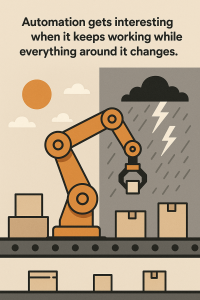
Stream data won’t wait. The system either decides now or pays later in rollbacks, refunds, and reputation.
An adaptive stack pairs event streams with policy-aware models. It chooses, explains why, and logs the breadcrumb trail for auditors.
≤ 50ms
Decision budget for user-facing actions
100%
Decisions recorded with rationale
Tiered
Guardrails: deny, degrade, or ask
Fast is nice. Fast, accountable, and reversible is the bar.
Self-healing systems: ops, but on autopilot
Picture this: a deployment spikes error rates. Before Slack wakes up, the platform quarantines the canary, rolls back, opens an incident, and attaches the diff.
No heroics, no finger-pointing. Just a quiet save and a note for Monday’s retro.
- Health budgets with automatic traffic shedding.
- Policy-gated rollback and feature flag fallbacks.
- Root-cause hints from embeddings + logs, not vibes.
Creative problem-solving: automation that suggests, not just executes
Tasks are easy; tradeoffs are messy. The next wave proposes options “three fixes, ranked by blast radius” and simulates outcomes before touching prod.
That’s not replacing judgment. That’s giving you a better chessboard.

The adaptive loop: sense → decide → act → learn
Static playbooks stale quickly. An adaptive loop retrains, retests, and redeploys in small bites no drama, just cadence.
Tiny loops, tight scopes, fewer surprises.
Guardrails without handcuffs
Automation earns trust when it knows its bounds. Rate-limits, human-in-the-loop on high-impact actions, and shadow mode before full send.
Also: measurable ethics. If a decision affects money, health, or safety, your policy engine needs explicit fairness checks not a wish and a shrug.
Write policies like code, test them like code, and treat overrides like hot sauce sparingly.
Architecture that doesn’t fight you
The stack should be boring in the best way. Events in, decisions out, clean APIs in between.
- Streaming core: Kafka/PubSub or equivalent. Schema first.
- Feature store: fresh, versioned, explainable.
- Policy engine: human-readable rules that models must respect.
- Action layer: idempotent commands with rollback paths.
- Observability: traces + embeddings for “why,” not just “what.”
Metrics that actually matter
Vanity stats age poorly. Pick signals that change behavior.
MTTR ↓
Minutes saved per incident
Defects ↘
Escapes per 1k changes
Assist Rate ↑
Human steps avoided safely

People: the underrated edge
Tools don’t create culture. People do.
Upskill ops as product thinkers, pair engineers with analysts, and rotate duty so everyone feels the pager and the customer.
Small note: write runbooks like recipes. Clear steps, photo-worthy endings.
Start small. Ship weekly. Learn loudly.
Pick one journey. Add sensing, a single decision, and one safe action. Measure. Then add the next turn of the loop.
Momentum beats grand plans and reduces the chance of a very expensive “ta-da” that nobody uses.
A quick starter blueprint
If it feels boring, you’re doing it right.