Last updated: June 10, 2026 · By Rezaul Hoque Turjo · 9 min read
Claude Fable 5 launched on June 9, 2026 and it isn’t just another model update. It’s the first time Anthropic has publicly released a “Mythos-class” AI, a capability tier the company previously kept locked behind a vetted-partner program because of misuse concerns. Anthropic says the model “exceeds every model” it has ever made generally available. Two months ago, this technology was restricted to a closed cybersecurity program. Today, anyone with a paid Claude plan can use it.
I build AI products daily at NextCTL, so I spent launch day digging into what actually changed, what it costs, and the one architectural decision in this release that I think every AI company will copy within a year.
TL;DR: Claude Fable 5 is Anthropic’s most powerful public AI model, launched June 9, 2026. It’s built on the restricted Claude Mythos architecture, leads nearly every benchmark, costs $10/$50 per million tokens (input/output), and automatically routes high-risk queries to the weaker Opus 4.8. It’s included free on paid plans until June 22, 2026.
What Is Claude Fable 5?
Claude Fable 5 is a Mythos-class AI model from Anthropic that delivers state-of-the-art performance in software engineering, knowledge work, vision, and scientific research, with built-in safeguards that block high-risk capabilities. It shares its underlying architecture with Claude Mythos 5, a more powerful sibling restricted to approved organizations.
The key concept here is the new capability tier. Anthropic’s lineup used to top out at Opus. Fable 5 sits above it, a tier the company says shows its largest lead precisely on the longest, most complex tasks. The harder the job, the bigger the gap.
Three things define the release:
- Capability: state-of-the-art on nearly all tested AI benchmarks, with standout results in coding, vision, and long-running agentic tasks.
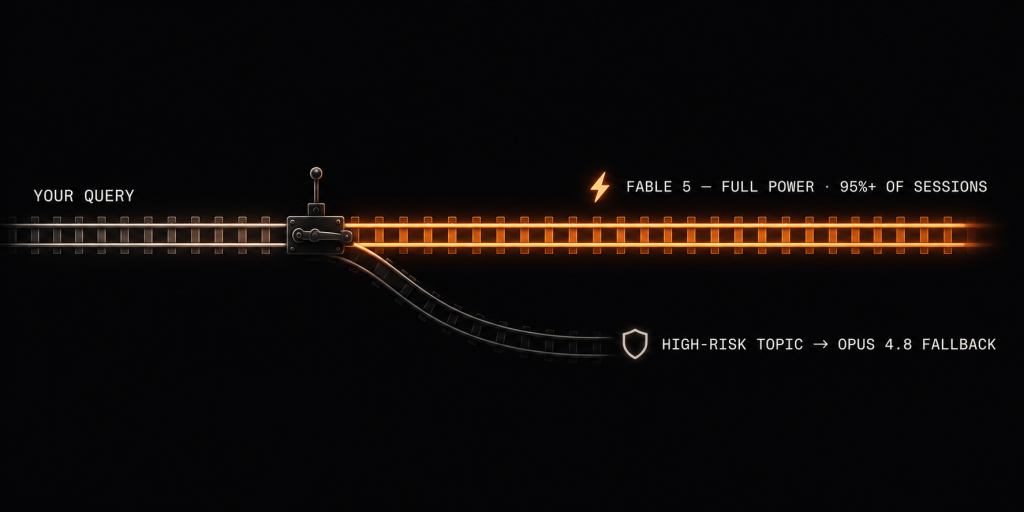
- Safety architecture: queries touching high-risk domains (cybersecurity, biology, chemistry) automatically fall back to Claude Opus 4.8 instead of being answered by Fable 5.
- Access model: generally available via Claude apps, the API, and paid plans — while the unrestricted Mythos 5 stays gated to trusted partners.
The Backstory: Why Was Mythos Locked Away?
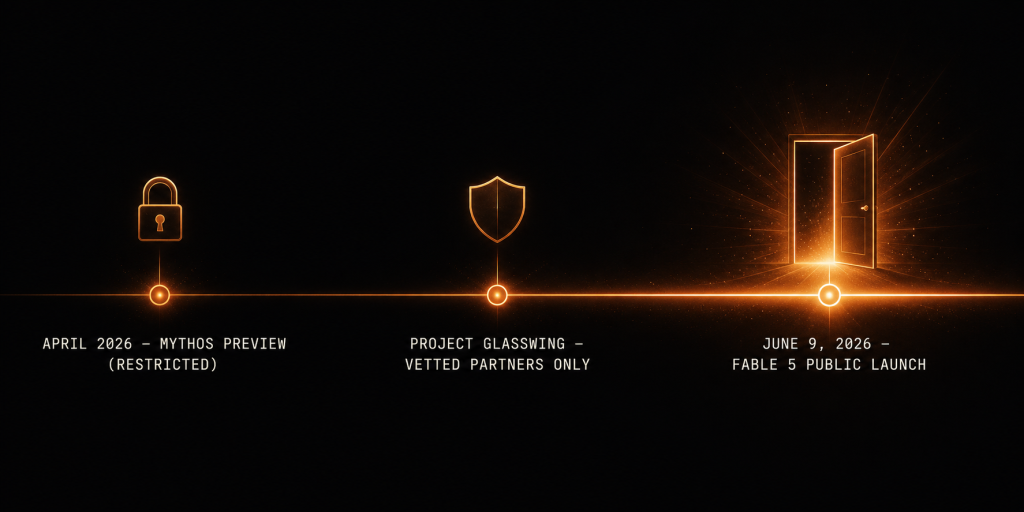
Mythos was restricted because it was exceptionally good at finding software vulnerabilities, a dual-use capability Anthropic judged too dangerous for open release. When Mythos debuted as a preview in April 2026, access was limited to vetted partners such as Microsoft, Amazon, and Cisco through a cybersecurity initiative called Project Glasswing.
Anthropic initially stated it had no plans to make the model generally available. Dianne Penn, Anthropic’s head of product management for research, has explained the restricted rollout as protection against misuse. The company has since expanded Project Glasswing to hundreds of organizations across 15 countries and with Fable 5, it’s now honoring its stated long-term goal of deploying Mythos-class models at scale.
How Good Is It? The Early Results
Early real-world results suggest Fable 5 meaningfully compresses engineering timelines rather than just improving benchmark scores. Two examples stand out from launch coverage:
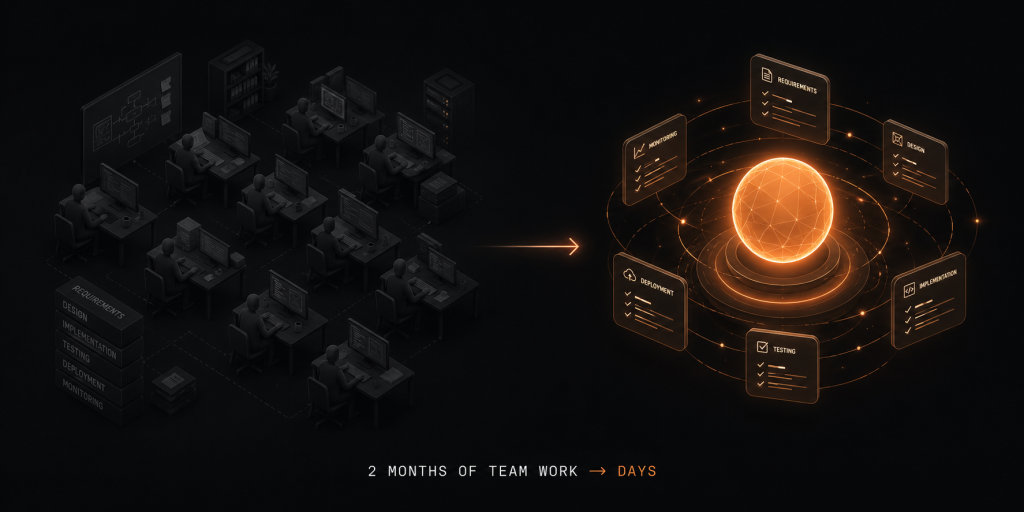
- Stripe reported that Fable 5 compressed months of engineering work into days.
- The model completed a large Ruby codebase migration estimated to take a full engineering team more than two months.
Vision is the sleeper capability. Anthropic calls Fable 5 its strongest vision model ever — able to extract precise figures from dense scientific charts and even rebuild a web app’s source code from screenshots alone. For anyone automating workflows that live in dashboards, PDFs, legacy software, or scanned documents, that’s a direct unlock: agents can now operate where no clean API exists.
The Genius Move: Fallback Routing Instead of Refusals
Fable 5’s most important innovation isn’t a benchmark — it’s how Anthropic handles dangerous capability. Instead of refusing risky questions outright, the system detects high-risk topics and silently routes those queries to the less capable Opus 4.8. Everyone else gets full Mythos-class power.
Early usage data shows at least 95% of sessions run entirely on Fable 5 without ever triggering the fallback. In practice: builders feel no friction, while the highest-risk capability stays out of reach.
This matters beyond Anthropic. The industry has been stuck between two bad options — release everything and hope, or refuse so much that the product feels neutered. Tiered capability routing is a third path, and my prediction as someone shipping AI products: this becomes the standard deployment playbook for frontier models within 12 months.
Claude Fable 5 vs Opus 4.8: Pricing and Access
Claude Fable 5 costs $10 per million input tokens and $50 per million output tokens — double the price of Claude Opus 4.8. Here’s the side-by-side that matters:
| Factor | Claude Fable 5 | Claude Opus 4.8 |
|---|---|---|
| Capability tier | Mythos-class (new top tier) | Opus-class (previous flagship) |
| API pricing (per 1M tokens) | $10 input / $50 output | Roughly half of Fable 5 |
| Best at | Long, complex, agentic tasks; vision; large codebases | Everyday production workloads at lower cost |
| High-risk domains | Routes to Opus 4.8 automatically | Standard safety behavior |
| Plan access | Included on Pro, Max, Team, Enterprise until June 22, 2026 | Standard availability |
The window: Fable 5 is included on paid Claude plans until June 22, 2026. After June 23, usage credits may apply while Anthropic expands capacity. If you want to test it at no extra cost, the clock is running.
How to Get the Most Out of Fable 5 This Week
Here’s the exact sequence I’d run (and am running) before the free window closes:
- Pick your gnarliest backlog item — the refactor or migration you’ve postponed for months. Long, complex tasks are where Fable 5’s lead is largest.
- Test the vision capability on a real workflow: feed it dashboard screenshots or a scanned PDF process and ask for working automation code.
- Run a head-to-head against your current model on one production prompt set. Measure quality delta, not vibes.
- Price-model the upgrade: at 2x Opus cost, Fable 5 only wins where the quality delta saves human hours. Map which of your workloads clear that bar.
- Try a long-running agent task — multi-hour, multi-step. This is the headline strength and the hardest thing to evaluate from benchmarks alone.
- Document your results before June 22 so your post-window spending decision is data-driven.
My Take: The Model Isn’t the Story
Every Fable 5 headline focuses on capability. I think that misses it. The real story is that Anthropic found a way to ship frontier capability commercially without shipping frontier risk — and did it two months after saying this class of model wouldn’t be public at all.
For founders and builders, the takeaway is strategic: the ceiling on what you can delegate to AI just moved again. Codebase migrations, screenshot-to-source reconstruction, multi-hour autonomous work — these were “next year” capabilities last quarter. Your competitors get the same access on June 9 that you do. The advantage goes to whoever restructures their workflows around it first.
Frequently Asked Questions
Is Claude Fable 5 free to use?
Partially. Fable 5 is included on Claude Pro, Max, Team, and Enterprise plans until June 22, 2026. After June 23, additional usage credits may be required while Anthropic expands capacity. API access is paid from day one at $10/$50 per million input/output tokens.
What is the difference between Claude Fable 5 and Claude Mythos 5?
They share the same underlying model. Fable 5 is the public version with safeguards that block high-risk capabilities, while Mythos 5 has fewer restrictions and is available only to approved organizations, such as cybersecurity partners in Anthropic’s Project Glasswing program.
Is Claude Fable 5 better than Opus 4.8?
Yes, on capability. Anthropic states Fable 5 exceeds every previously available Claude model, with the largest gains on long, complex tasks. However, it costs roughly double Opus 4.8, so Opus remains the better value for routine production workloads where the quality gap matters less.
Why does Fable 5 fall back to Opus 4.8 sometimes?
It’s a deliberate safety design. When a query touches high-risk domains such as cybersecurity or biology, the system routes it to the less capable Opus 4.8 instead of refusing. Anthropic reports at least 95% of sessions never trigger this fallback.
Can developers access Claude Fable 5 through the API?
Yes. Fable 5 is available immediately through the Claude API using the model string claude-fable-5, priced at $10 per million input tokens and $50 per million output tokens. It also works in Claude Code and other Anthropic developer tools.
Key Takeaways
- Claude Fable 5 launched June 9, 2026 — Anthropic’s first public Mythos-class model.
- It exceeds every previous public Claude model; biggest lead on long, complex tasks.
- High-risk queries auto-route to Opus 4.8; 95%+ of sessions never notice.
- Pricing: $10/$50 per million tokens — double Opus 4.8.
- Free on paid plans only until June 22, 2026 — test it now.
Rezaul Hoque Turjo is the founder of NextCTL, an AI-native software and growth agency. He builds AI products and automation systems for clients across North America and shares founder-perspective AI breakdowns at turjo.me.